Gaussian Splatting Just Crossed the Line — It's in Nuke Now
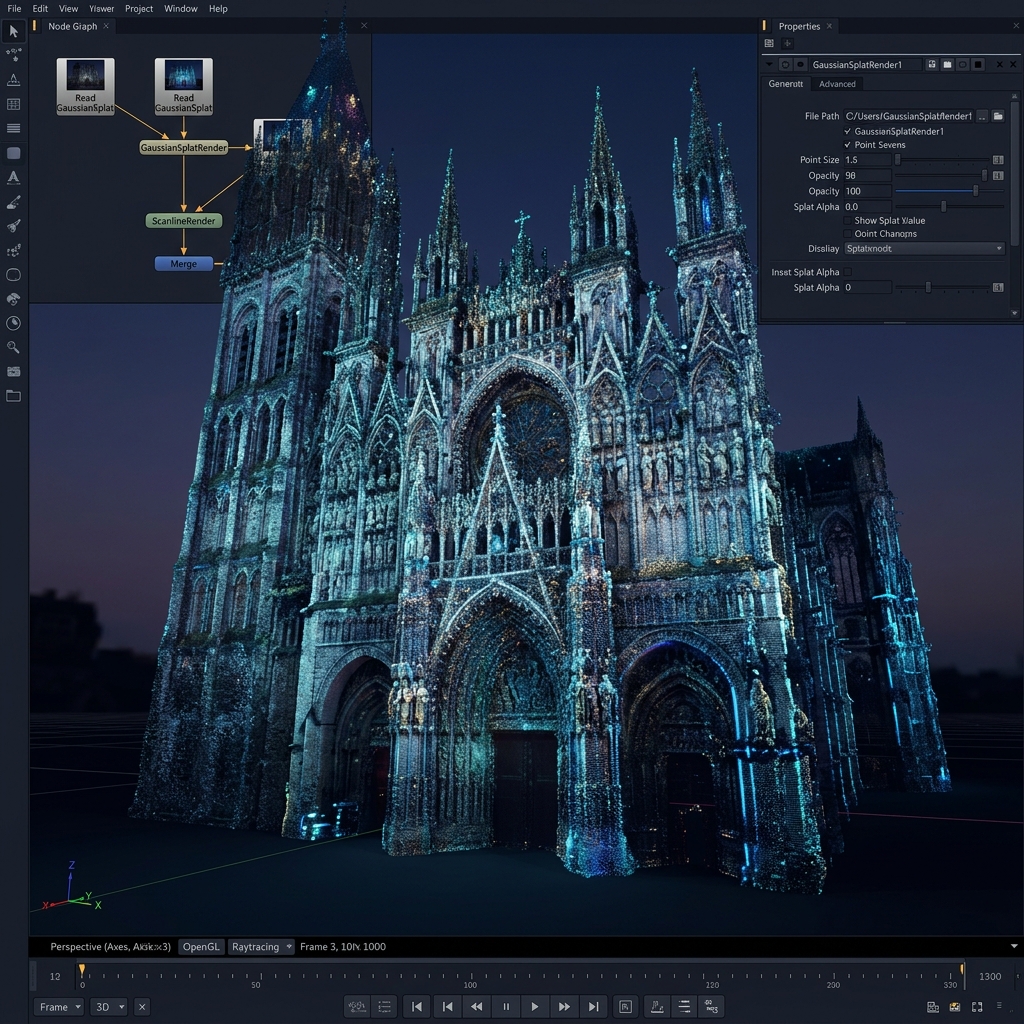
For about two years, Gaussian Splatting has been that cool VFX conference demo that always ends with the same heavy sigh: "The quality is insane for location scanning... but it doesn't fit into a real pipeline."
So we'd all nod, take another sip of lukewarm coffee, and go back to our desks to clean up broken photogrammetry meshes.
But that conversation officially ended in February 2026. Nuke 17.0 shipped with native Gaussian Splat support. It’s not a shaky third-party plugin or an experimental tool a Houdini TD cobbled together over a weekend. Nuke—the actual software we use to deliver final-pixel feature film shots—now speaks Gaussian Splats natively. If you’ve been pulling your hair out trying to integrate scan data, this is the shift you've been waiting for.
What is a Gaussian Splat, Actually?
Let’s skip the heavy math papers and keep it practical. Gaussian Splatting (a machine-learning method to represent 3D scenes as millions of colored, transparent particles) is essentially a way of recreating reality. Instead of turning photos into a rigid polygon mesh, it trains on regular photos or videos to figure out the position, size, color, and opacity of millions of tiny colored blobs (Gaussians).
When you render them, they blend together to create a photorealistic 3D scene.
Unlike traditional photogrammetry, there is no geometry to clean up, no UVs to unwrap, and no textures to bake. The splat cloud is the scene. The results are incredibly lifelike and render shockingly fast.
The problem was that none of this data talked to a standard VFX pipeline. No meshes, no shaders, no AOVs. For years, compositors like us couldn't do anything useful with it downstream. Until now.
What Nuke 17 Actually Changed
The new workflow is remarkably clean. You bring in your .ply or .splat files using the new GeoImport or GeoReference nodes, exactly like importing standard FBX or USD geometry. The actual rendering is handled by the new SplatRender node.
But here is what makes this production-ready rather than just a gimmick: SplatRender outputs proper depth passes, deep output (multilayer depth pixels), and motion blur.
That means you aren't just stuck with a flat image. You get true depth data to comp CG elements directly into the splat environment. You can color grade it, grade-match it to your plate, key characters behind objects, and add atmospheric haze—all using the standard Nuke tools you already know.
For scanned location environments—like a specific building facade, a forest clearing, or a practical set that has already been torn down—this is a massive game-changer. Scan the location once on set with a phone or camera, generate the splat cloud, and the comp team can integrate CG elements with photographic accuracy. No more painting out seams or fighting broken geometry.
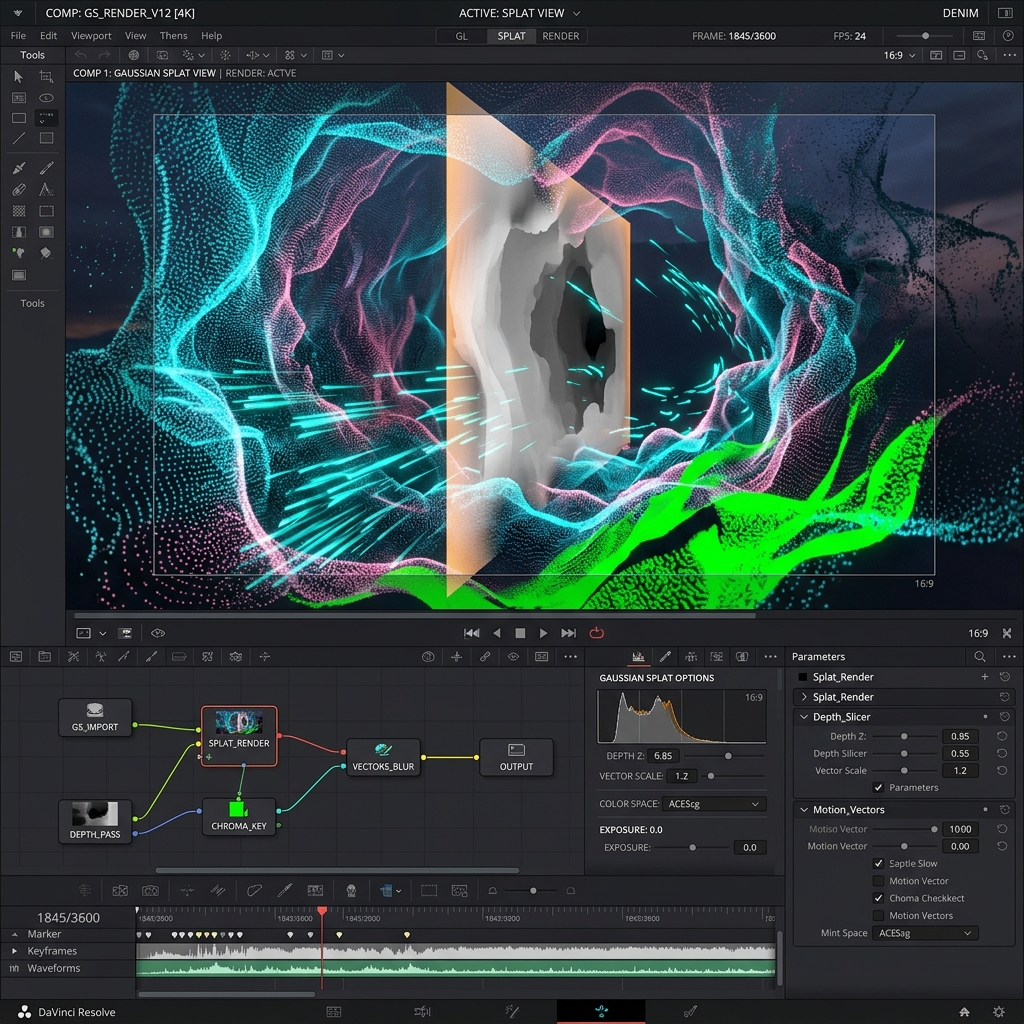
FIG_01: Native Gaussian Splat support in Nuke 17 — splats import as standard geometry and render through the new SplatRender node with depth, deep, and motion blur outputs.
Houdini is Right Behind
Houdini 21 has also shipped a technical preview of native splat support, and third-party tools like the GSOPs (Gaussian Splatting Operators) plugin have quietly become incredibly powerful. They feature full USD integration, Solaris-native LOP nodes, and support for real splat relighting, shadows, and reflections inside the Karma renderer.
This is a bigger deal than it sounds. It means your splat environments aren’t just static photographic backdrops anymore. They react dynamically to your actual CG lights. If you're building a library of digital locations, this workflow will completely change how you approach environment integrations.
The Ultimate Proof: Superman (2025)
If you're still skeptical, here is the number that matters. Framestore used 4D Gaussian Splatting to deliver approximately 40 final-pixel shots in Superman (2025).
Let that sink in. Forty final-pixel shots in a massive theatrical release. Not previs, not a tech demo, not a side experiment.
4D splatting extends the technology by adding the dimension of time—capturing not just how a scene looks, but how it moves. Framestore successfully deployed this at scale on a major blockbuster, which is the ultimate industry stamp of approval.
What This Means for Your Comp Workflow
Let’s be honest: this isn't going to replace your daily compositing workflow tomorrow. It's an addition to the toolkit, not a replacement.
The immediate use case is scanned location environments. When a production needs CG characters to convincingly inhabit a real location that is too expensive or logistically impossible to rebuild in CG, Gaussian Splatting is now a viable, high-fidelity path.
Your core job as a compositor remains identical—focus on edge integration, color grading, matching camera grain, depth, and motion. You're simply working with significantly better source material.
However, the real magic happens when you combine splat data with AI-assisted extensions. A splat only represents what was actually scanned. If you need to extend a wall, add a window, or fill in a blind spot where the camera couldn't go, you can build a photorealistic splat foundation and layer generative AI extensions right on top of it.
The Honest Rough Edges
I always believe in giving you the real, unfiltered truth. Gaussian Splatting is fantastic, but it still has some serious pipeline challenges:
- Transparency is still a headache: Reflective or transparent surfaces (like glass or water) confuse the underlying algorithms. The math struggles to separate the reflective surface from the background. You'll still need to isolate and handle these elements manually.
- Movement is incredibly complex: A static environment works beautifully. But a street filled with moving cars or a bustling crowd requires complex workarounds or multiple dynamic scans.
- File sizes will choke your local storage: High-resolution splat clouds are heavy. If your pipeline TDs haven't optimized your local caching or network storage, a massive splat environment will bring your viewport to a crawl. I call this the "Splat Storage Tax"—always allocate at least double the cache size you think you'll need!
💡 The Wrap-Up: Ground Yourselves in the Physics
The VFX industry is moving fast. Between generative AI, real-time engines, and capture technologies like Gaussian Splatting, the line between raw photography and CGI is thinner than ever.
But here is my advice: don't panic, and don't get distracted by the hype. The core skillset of a great compositor will never change. Color, light, depth, and seamless integration are the physical laws of our universe. Whether you are compositing a flat plate or a 3D Gaussian Splat cloud, your eye for detail and understanding of camera physics are what make the shot look real.
Nuke 17 is out, and the tools are ready. Go grab a splat file, open up a script, and start playing with it. The best way to learn is to break it yourself!