Generative AI in Feature Film VFX: What It Actually Looks Like in Practice
These days, we hear a ton of marketing hype about how "Generative AI is going to completely revolutionize and replace filmmaking." Frankly, it's enough to give anyone a headache. Most of these conversations stop at flashy concept clips shown off on social media.
As someone who has been working as a compositor in feature film VFX for years, what I actually want to share in this breakdown is the "reality on the ground." How do we actually integrate neural tools into a professional feature film pipeline on a live show? What actually works, what is still absolute garbage, and what does all of this mean for the lives of compositors like us?
The Classic Pipeline Problem We Tried to Solve
Traditional VFX pipelines are linear by design: Concept Art feeds Modeling ➜ Look Development ➜ Lighting ➜ and finally Compositing (Comp).
This sequence made sense historically because it kept production costs in check. But its fatal flaw is that late-stage change requests—like a director wanting to try a completely different location or shift the time of day from noon to sunset three weeks before delivery—are prohibitively expensive and time-consuming because you have to loop all the way back to the upstream departments.
Our goal when integrating AI was never to replace our talented artists. Instead, it was to build a "parallel track" that allows background elements and environments to be iterated directly in the compositing stage, without having to bug the upstream departments to rebuild everything from scratch.
How the System Was Actually Built
Because feature film work is bound by incredibly strict copyright and data security parameters, we can't just upload production plates to external web clouds to generate images.
Instead, we deployed localized generative models running on an air-gapped local cluster (completely severed from the internet) inside our studio. The models were trained exclusively on the show's own approved look-development data—concept art, approved lighting references, and authorized set photography.
Our compositors accessed the system through a custom interface directly integrated inside Nuke, working as a Write/Read loop. When we selected a specific region in Nuke and sent the generation request, the results returned as standard EXR sequences that fully support the pipeline's dynamic range and color standards.
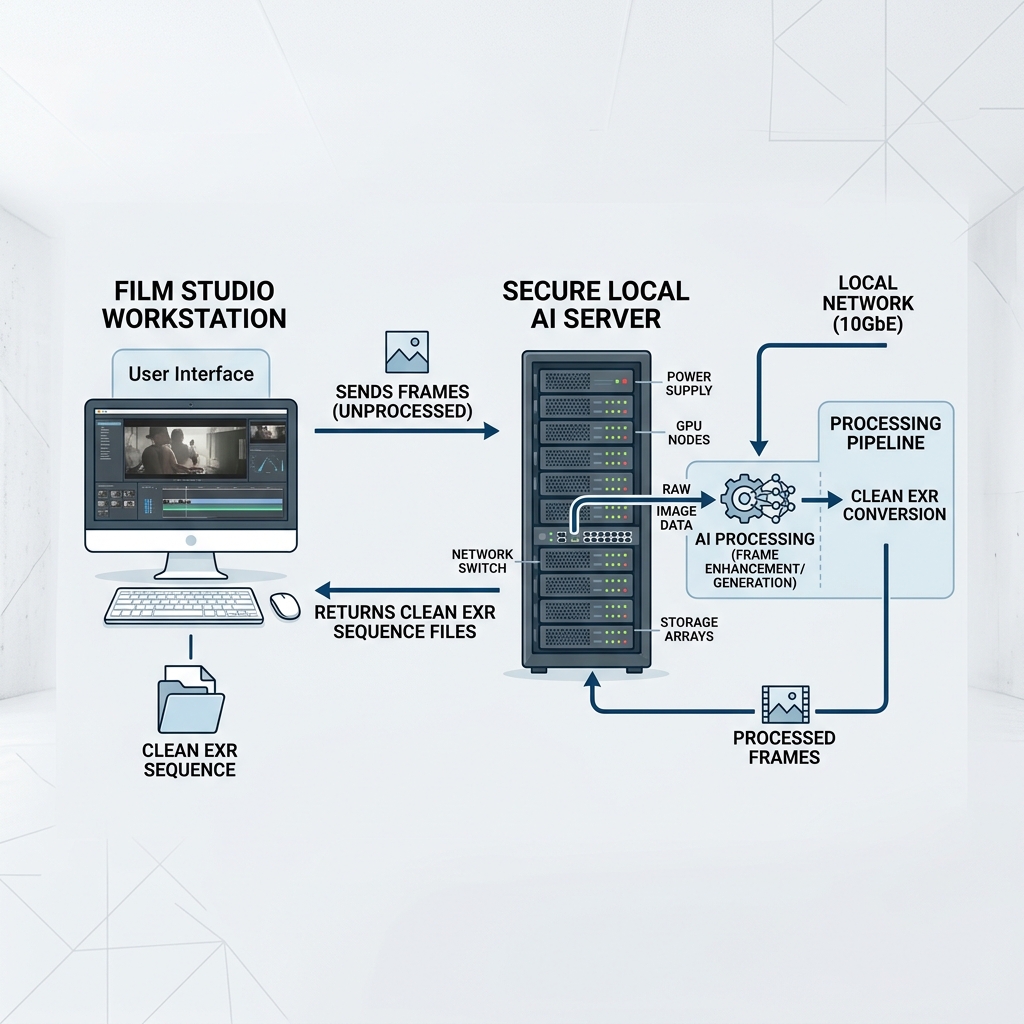
FIG_01: Pipeline flow showing secure Local Inference Server setup — running directly inside a studio firewall to safely process frame generation requests into EXR sequences without exposing proprietary data.
What Actually Changed and Worked Flawlessly
For distant background elements—faraway buildings, foliage fills, sky replacements, and atmospheric expansions—the iteration cycle dropped from "days" to "hours."
A compositor could generate 12 different environment variations, review them in context in the shot, and lock a creative direction with the director before the end of the day. Historically, that would have required an upstream matte-painting request and days of back-and-forth reviews.
Another massive quality-of-life improvement was AI-assisted Rotoscoping. On dense crowd shots and complex clothing elements, manual cleanup passes were still required on the most difficult frames—but overall, the total roto time on those shots dropped by roughly 40%.
Upscaling was another very straightforward, high-impact integration. Running approved elements through a model trained on the show's specific grain structure and resolution profiles gave us clean, crisp results that fit perfectly into our standard final delivery prep.
The Limits and the Ethical Framework We Must Respect
Our system operated under strict ethical parameters. The models were trained exclusively on licensed or proprietary in-house data. Every single generated element required compositor sign-off and was treated strictly as "raw material" to be further crafted by human hands—never as a final, straight-out-of-the-box deliverable.
At the end of the day, AI in this pipeline serves as a tool to accelerate and ease the heavy lifting on specific, well-defined problems. It cannot—and will never—replace the "artistic taste and creative judgment" of human artists.
The tasks that still take the most skill, care, and production hours are exactly what you'd expect: complex foreground integration, historical and blueprint-accurate details, and shots requiring high technical precision.
The balance between human and machine will continue to shift as technology evolves. But right now, the most valuable skill a compositor can develop is a clear-eyed, realistic understanding of exactly where in the pipeline these tools earn their place... and where they absolutely do not.