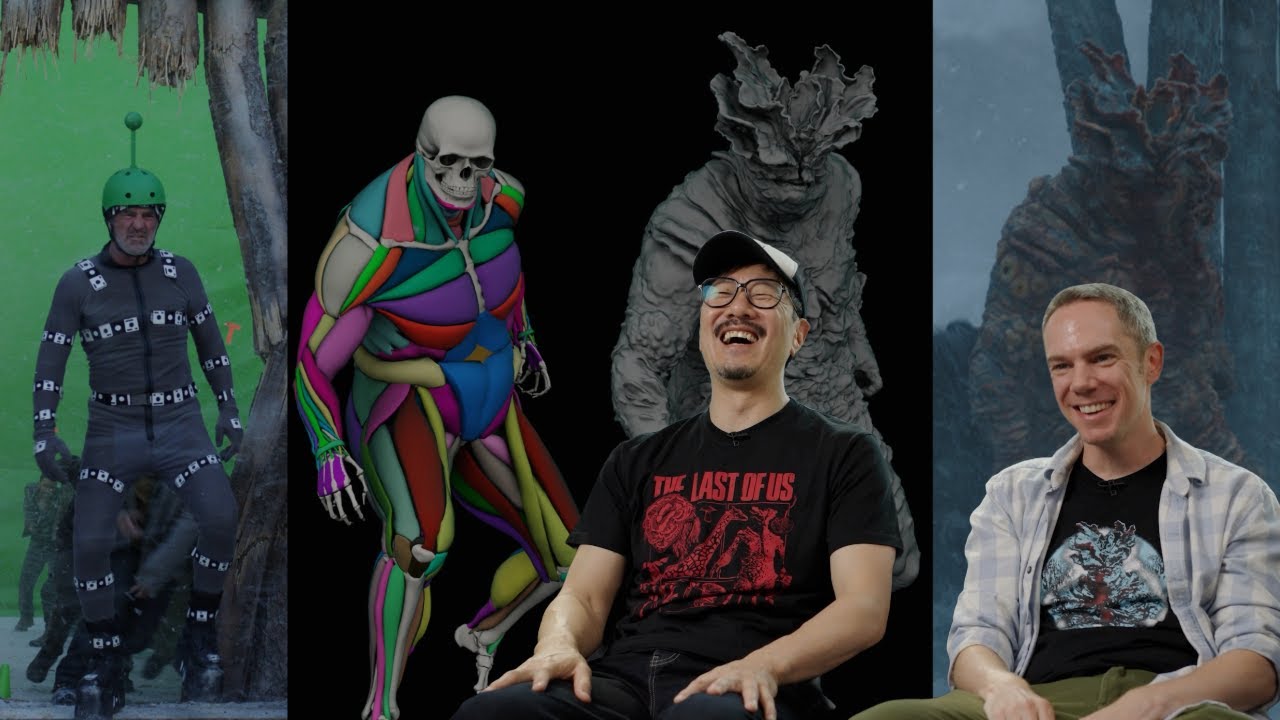
The Last of Us Season 2: How Wētā FX Built the Infected Horde
I just finished watching the Jackson attack in Season 2, and in my view as a VFX artist, something felt incredibly special. The way the infected move is completely different from your run-of-the-mill, generic zombie. They move with an unsettling, erratic physicality that makes your hair stand on end.
It doesn't feel like actors in makeup anymore; it feels biological, triggering a deep instinct in your brain that says: this used to be human, but it definitely isn't anymore.
That's not an accident. The masterminds over at Wētā FX spent nearly two years rebuilding the systems behind these creatures from scratch. Here's a breakdown of what that actually looked like on the ground.
Controlling Thousands of Infected as a Single Horde
The Jackson siege sequence required thousands of infected on screen at once. Hand-animating that many characters is completely impossible under production schedules—the only way forward is building a crowd simulation smart enough to make decisions on our behalf.
Wētā reached for Massive, the legendary crowd software that once populated Middle-earth with armies. But the level of specificity they built into the agent pipeline for this show was outstanding.
Every single agent in that crowd carries its own unique Cordyceps growth state, its own injury history, and its own set of fungal tendrils overriding its muscular system. There are no generic infected templates being copy-pasted across the horde. Even the background characters you only catch for a fraction of a second are built out with this depth—because if the camera swings past them, the simulation must hold up.
A neat trick that rarely gets discussed in public breakdowns is that the hero infected in close-ups are completely separate assets from the crowd agents behind them. These two parallel pipelines were engineered to blend seamlessly, allowing us to cut back and forth without the audience ever noticing the seam.
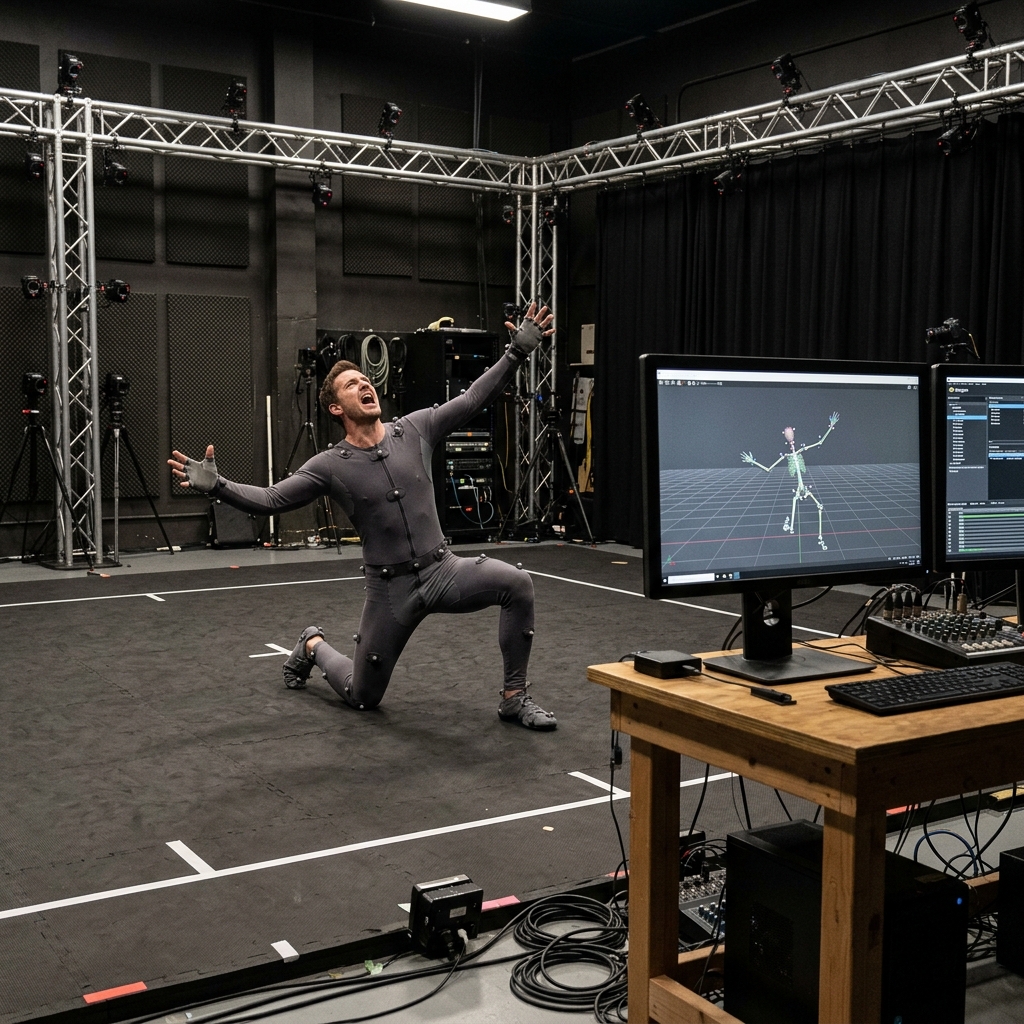
FIG_01: Motion capture recording session on Wētā FX stage, capturing skeletal coordinates and human movements before applying the animation rigs.
The Snow Simulation Challenge
Seattle in the winter is wet, freezing, and buried in snow. Every single particle of that snow needs to react dynamically to whatever is happening on top of it. Imagine characters sprinting through deep drifts and infected slamming face-first into the ground at high speeds—then multiply that by a thousand. It's a massive computation nightmare that is ready to bring any render farm to its knees 555.
Nick Epstein and Dennis Yoo solved this complex simulation problem by separating it into distinct layers. The wide environment snow is procedural—using displacement maps driven by where the crowd agents move.
However, any area with direct hero-character interaction or direct contact with an actor got the full physics treatment: a rigid body solver for compressed snow, a particle system for the spray, and a pass of Wētā's in-house effects solver, Loki, for fine debris.
The real craft here is knowing when to stop. Snow simulation is incredibly expensive, television schedules are brutal, and the art lies in finding the exact minimum fidelity that still reads as flawless on a 65-inch screen at home.
The Art of Blood, Light, and Fire
Season 2 pushes its action sequences into places Season 1 never went. The infected battles feature fire, intense burns, and physical brutality that pushed the compositing team into entirely new territory. The gore system was built directly inside Nuke—a custom particle-based rig driven from the same geometry cache as the rendered creatures.
This means that the blood spatters and wound deformations interact mathematically with the creature's physical shape, rather than floating in a separate 2D FX pass that compositors have to manually paint and align.
This saves hours of work per shot, especially when you're trying to match flickering firelight onto a burning character who is moving aggressively through the frame. The fire itself was a beautiful mix of practical elements captured on set and CG extensions for shots where the real flames didn't read at the correct scale or direction.
Rebuilding the Bloater From the Skeleton Up

FIG_02: Close-up macro visualization of the fungal growths (Cordyceps) to establish specular reflection values and skin integration parameters for Look Development.
The Bloater is what happens when Cordyceps has had years—possibly decades—to consume a human host. For Season 2, Wētā didn't just tweak their old Season 1 model. They built a brand-new asset from scratch.
The heavy mass of fungal growth covering its body runs through Wētā's custom Dynamic Refitting system. This allows secondary geometry—like the spore sacs, armored fungal plates, and hanging tendrils—to deform and collide against the primary skeleton with their own physics.
When the Bloater smashes through a wall, that fungal mass doesn't just move rigidly with the bones. It slaps, compresses, and bounces back according to its own weight and elasticity, independently of whatever the animation skeleton is doing.
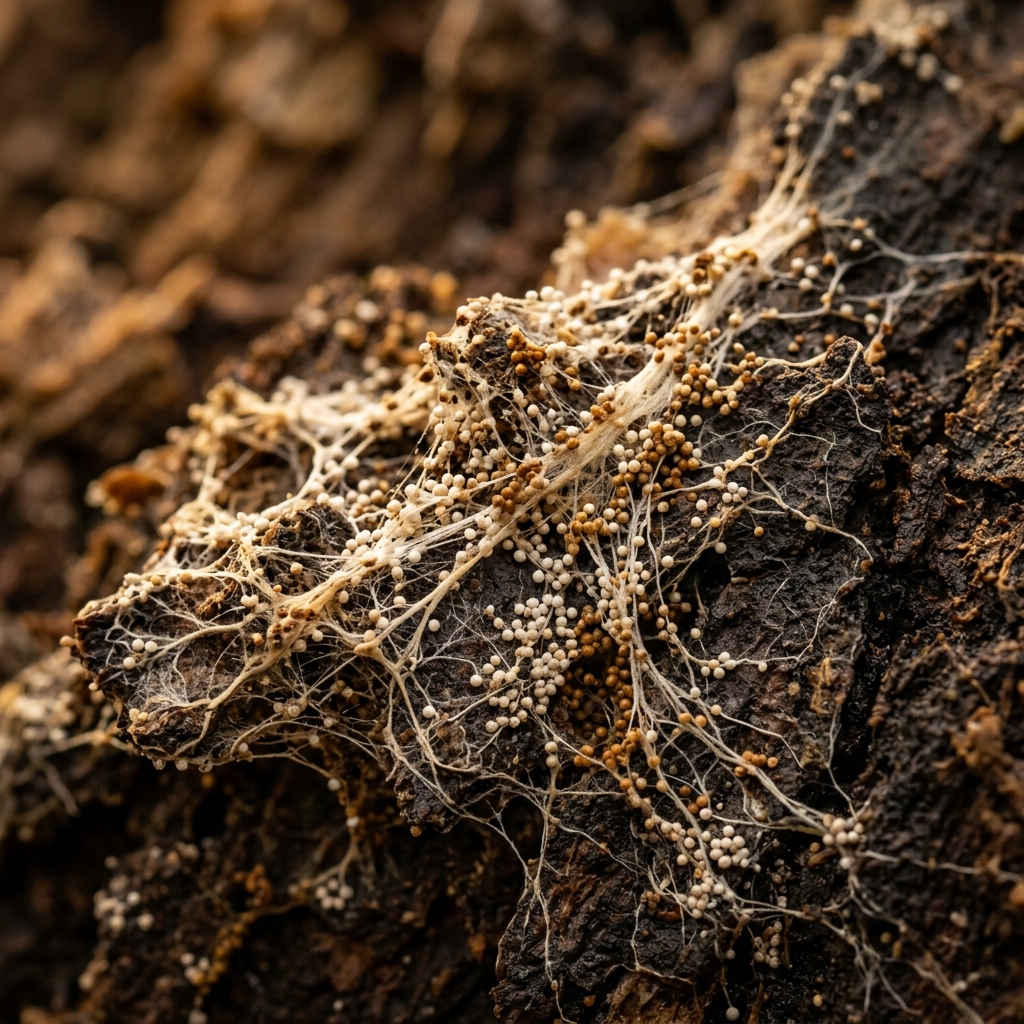
FIG_03: Close-up of the detailed fungal spore structures covering the Bloater's outer shell, ensuring realistic light scattering across Wētā's dynamic refitting passes.
Even though most of its face is buried under thick layers of fungal growth, Wētā still rigged the face using a FACS (Facial Action Coding System) setup. Animators still needed to control the jaw, brow, and eyes to convey a sense of primal drive. An enemy that reads as completely blank loses its edge; the horror comes from feeling that there is still a desperate, ravenous consciousness trapped inside.
Why CG Dogs Are a Nightmare Compared to Monsters
Ask any creature artist and they will tell you the same thing: "Dogs are the single hardest thing to get right in VFX." They are harder than wolves, and way harder than fantasy monsters that don't exist in the real world.
The reason is simple: humans have spent their entire lives looking at dogs. Our brains are incredibly fine-tuned to spot when a dog's behavior, muscle movement, or weight feels even slightly off.
Season 2 required CG dogs in stunts and dangerous scenes where using real animals wasn't possible. Each dog was built using Loki to drive fur simulation that accounts for wind, wet clumping, and muscle deformation underneath. The fur calculations alone required multiple passes per shot, and getting the contact interaction between the dogs and the actors' clothing and hair absolutely perfect was one of the densest technical challenges of the season.
The Massive Production Numbers

30 base models generating 400+ unique infected variations, 600 mocap cycles, cloth and hair simulation that took a full week per pass. The numbers behind what you saw on screen. Infographic: NotebookLM
For my fellow VFX artists or anyone curious about the outstanding work that goes into a production like this, the befores & afters interview with Wētā FX's team is a goldmine. It's incredibly inspiring and highly recommended!