How Kubrick Shot Africa Without Leaving London
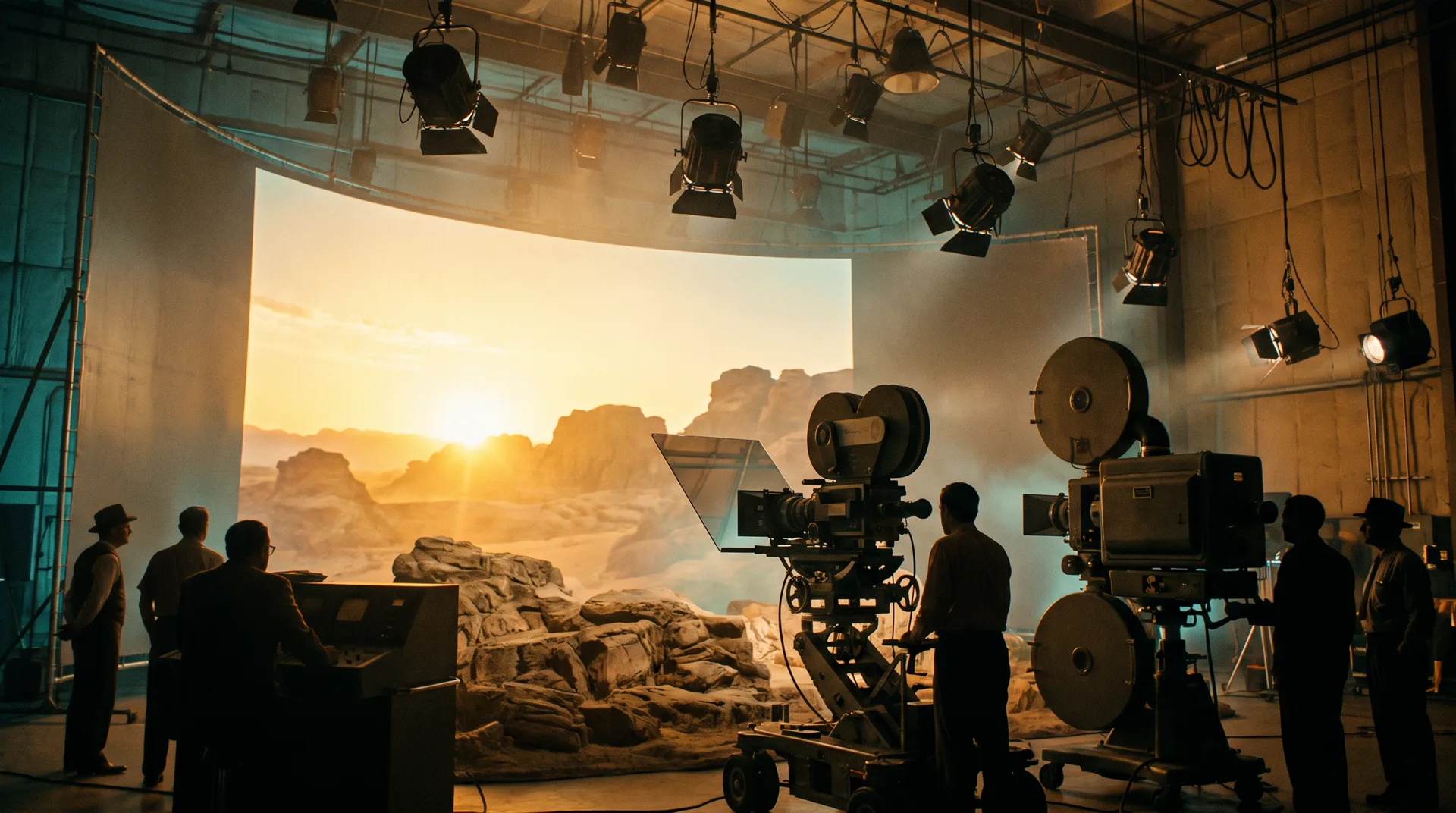
The first time I watched the opening of 2001: A Space Odyssey, I thought they'd dragged a film crew and a bunch of actors in ape suits all the way to Africa.
They didn't. The whole "Dawn of Man" sequence was shot on a sound stage outside London.
No green screen. No compositor fixing it later. The composite happened right there, inside the camera, while the actors were performing. As someone who spends his days pulling keys, that still blows my mind a little.
So let's open it up. How did it work, what gave it away, and what can we, as modern compositors, steal from it?
The Problem Kubrick Had
Kubrick and Arthur C. Clarke started working on the film in 1964. The opening needed early humans living in a huge, dry, ancient landscape.
Shooting it for real meant hauling actors in heavy ape costumes, crew and lights across the world, then praying for the weather. Kubrick was famous for wanting total control. A real desert gives you none.
The usual studio trick back then was rear projection. You put a screen behind the actors and project the background onto it from behind. It works, but the image tends to look soft and washed out, and you need a lot of studio space behind the screen.
For a sunrise over a prehistoric world on 65mm film? Soft and washed out wasn't going to cut it.
The Trick: Front Projection
So the team went with a technique that was still pretty rare: front projection.
Here's how it works, simply:
- The camera points straight at the actors.
- Right in front of the lens sits a beam splitter, a sheet of half-mirrored glass set at 45 degrees. Half the light passes through, half bounces off.
- A projector sits at 90 degrees to the camera. It shines the background image onto that glass, which bounces it forward, straight down the same line the lens is looking along.
- Behind the actors is a giant screen made of Scotchlite, a 3M material covered in tiny glass beads.
That last part is the magic. Those beads are retroreflective, which means they throw light straight back to where it came from, like the road signs that glow when your headlights hit them. The background bounces off the screen and goes straight back into the lens, bright and punchy.
The same image also lands on the actors. But skin and fur aren't retroreflective, so it scatters away and is way too faint to see.
Which means the actors become their own matte. No keying needed. In comp terms, the alpha is "baked" into the physics.
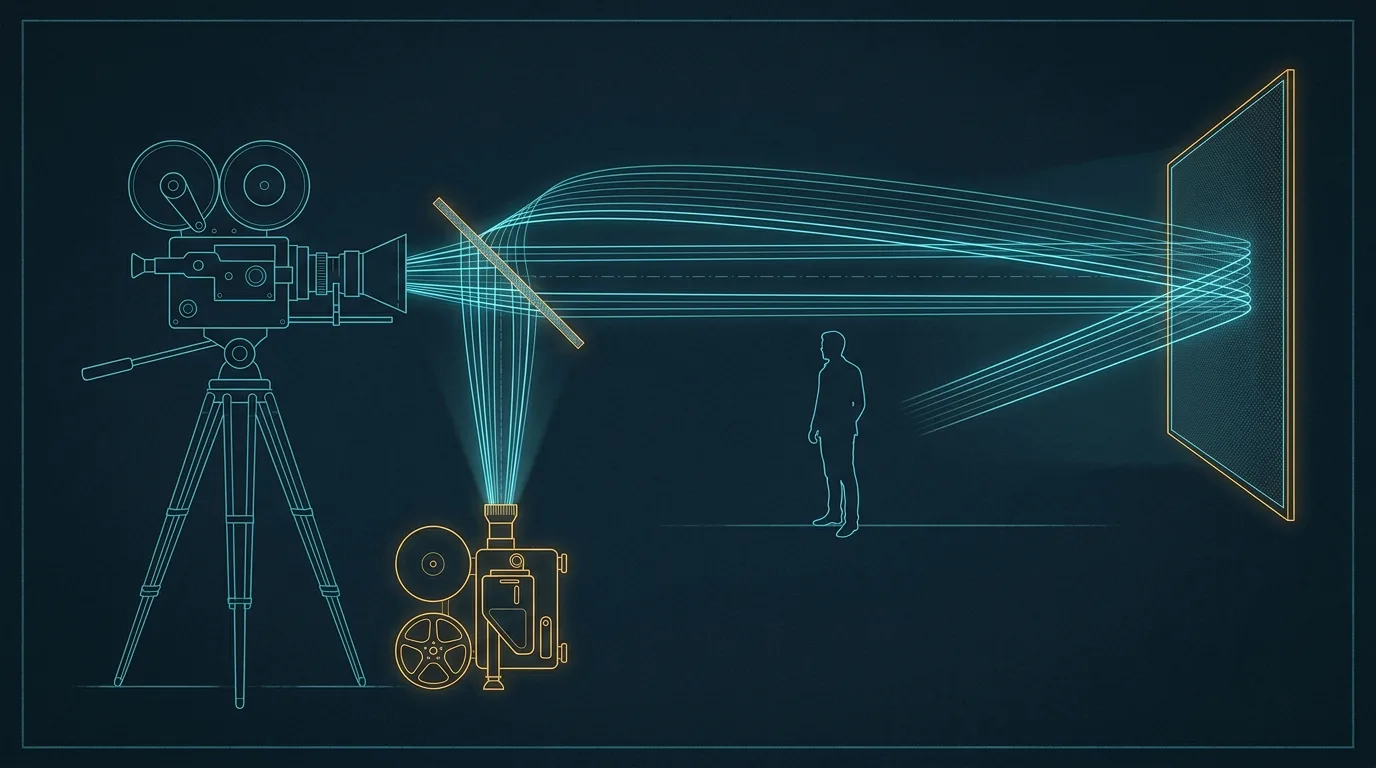
FIG_01: Front projection in one picture. The projector and the lens share the same line of sight, so the screen bounces the background straight back into the camera (illustration).
One important detail: the camera and projector have to be lined up on exactly the same axis. If they drift, you start seeing the actors' shadows on the screen. Sounds a lot like a bad edge in our world, right?
The technique itself wasn't Kubrick's invention. It was patented in the 1950s by Will Jenkins, a writer better known by his pen name Murray Leinster, and the Japanese film Matango (1963) was already using it. But 2001 took it to a scale nobody had seen before.
Africa in an 8x10 Envelope
This is the part I love, because it's pure "garbage in, garbage out" thinking.
In 1966, a small unit went to Southwest Africa (today's Namibia) to shoot the backgrounds. Not motion footage. Still photos, on huge 8x10 inch Ektachrome transparencies.
Why stills? Because a still frame on a huge piece of film holds an insane amount of detail. They actually tested smaller 4x5 transparencies first and found the result mediocre. So they went bigger.
Back at MGM-British Studios in Borehamwood, MGM effects man Tom Howard worked with Kubrick to build a projector strong enough to throw those giant slides onto a Scotchlite screen reported at about 100 feet wide. The lamp was so hot it could burn the transparency, so they used duplicates for line-up and tests and saved the good ones for the takes.
Kubrick also reused the same plates across several shots. A smart production move. Any compositor who's been handed the same clean plate for ten shots knows the feeling 555

FIG_02: What retroreflective screen material looks like up close. Millions of tiny glass beads that send light straight back to its source (illustration).
The Giveaway Is in the Eyes
So was it perfect? Almost.
Watch the scene where the leopard sits on the rocks. Its eyes glow. That's the projector light hitting the back of the animal's eyes and bouncing back into the lens. The very same physics that made the screen work.
I love this detail. Not because it "exposes" the trick, but because it's such a good lesson for us: the illusion breaks in the smallest highlights. Not in the big landscape. In a reflection the size of a few pixels.
How often do we spend hours on a sky replacement, then forget the reflection in someone's eyes or sunglasses? I've done it. Every supervisor I've worked with has caught it at least once.
The work paid off, by the way. 2001 won the Academy Award for Best Special Visual Effects, the only Oscar Kubrick personally ever won.
From Scotchlite to LED Walls
Front projection had a good run after that. Zoran Perisic refined it with his "Zoptic" system, adding synchronised zoom lenses on the camera and projector, and it became the main method for the flying scenes in Superman (1978). Cliffhanger (1993) is often called the last major blockbuster to lean on it heavily. Then digital compositing took over.
But here's the funny part. The idea came back.
On The Mandalorian, ILM used a system called StageCraft: walls of LED panels, around 20 feet high, showing backgrounds rendered in real time by a game engine (Unreal), with the perspective updating as the camera moves. About half the show was shot inside that "volume."
Different tech, same dream as Kubrick's stage: put the world behind the actor, and get the shot in camera. And just like back then, the real bonus is light. The background actually lights the actors and shows up in shiny surfaces, which is exactly the thing we fight so hard to fake on green screen.
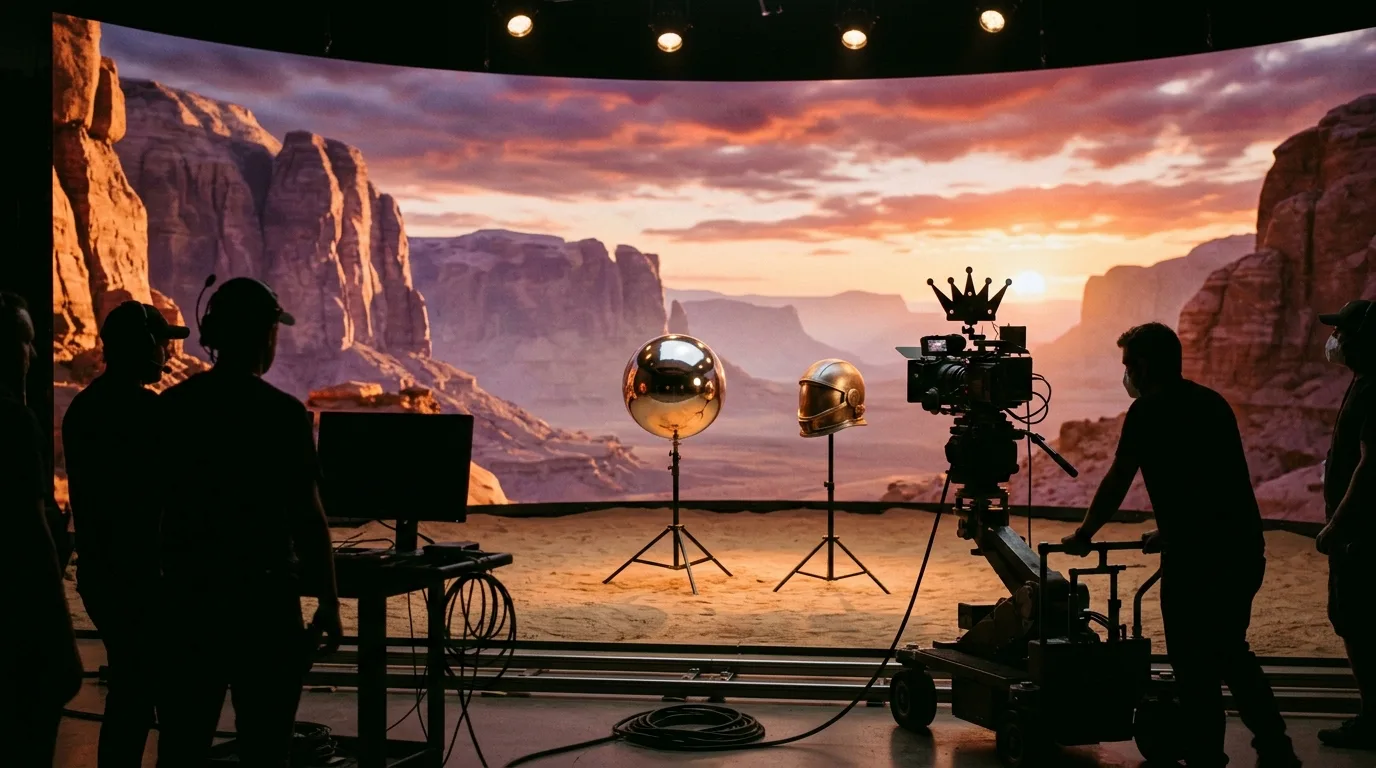
FIG_03: Sixty years later, the same dream with new hardware. An LED volume lights the set and shows up in every reflection (illustration, not a real production).
What I Take Back to My Comp
Am I worried that "in camera" means compositors are out of a job? Not really. My honest opinion: these setups don't remove comp work, they move it. Someone still has to clean up seams, fix plates that went soft, and swap backgrounds when the director changes their mind.
But Kubrick's stage gives me three habits I try to keep:
- Ask for the best plate you can get. They went from 4x5 to 8x10 because the result wasn't good enough. Resolution and clean plates upstream save you days downstream.
- Light first, edges second. The reason in-camera tricks feel real is that the light is real. When a CG element looks "pasted on," check the light before you blame the edge.
- Hunt the tiny highlights. Eyes, glasses, chrome, wet surfaces. Before you render, do one pass just looking for reflections that should be there, or shouldn't.
💡 The Wrap-Up: Great Tricks Never Really Die
I started out as a computer teacher, not a film student. I learned most of this the long way, one failed shot at a time. Stories like this remind me that every "new" tool I get excited about usually has a grandparent from the 1960s.
That's comforting. It means the basics we learn today, light, plates, edges, reflections, won't go out of date. The hardware changes. The eye stays the same.
So next time you're stuck on a shot, think of a stage in London pretending to be Africa, and a leopard with glowing eyes. Then go make your shot a little more honest. You've got this.